 vaydantaa
 December 17, 2025


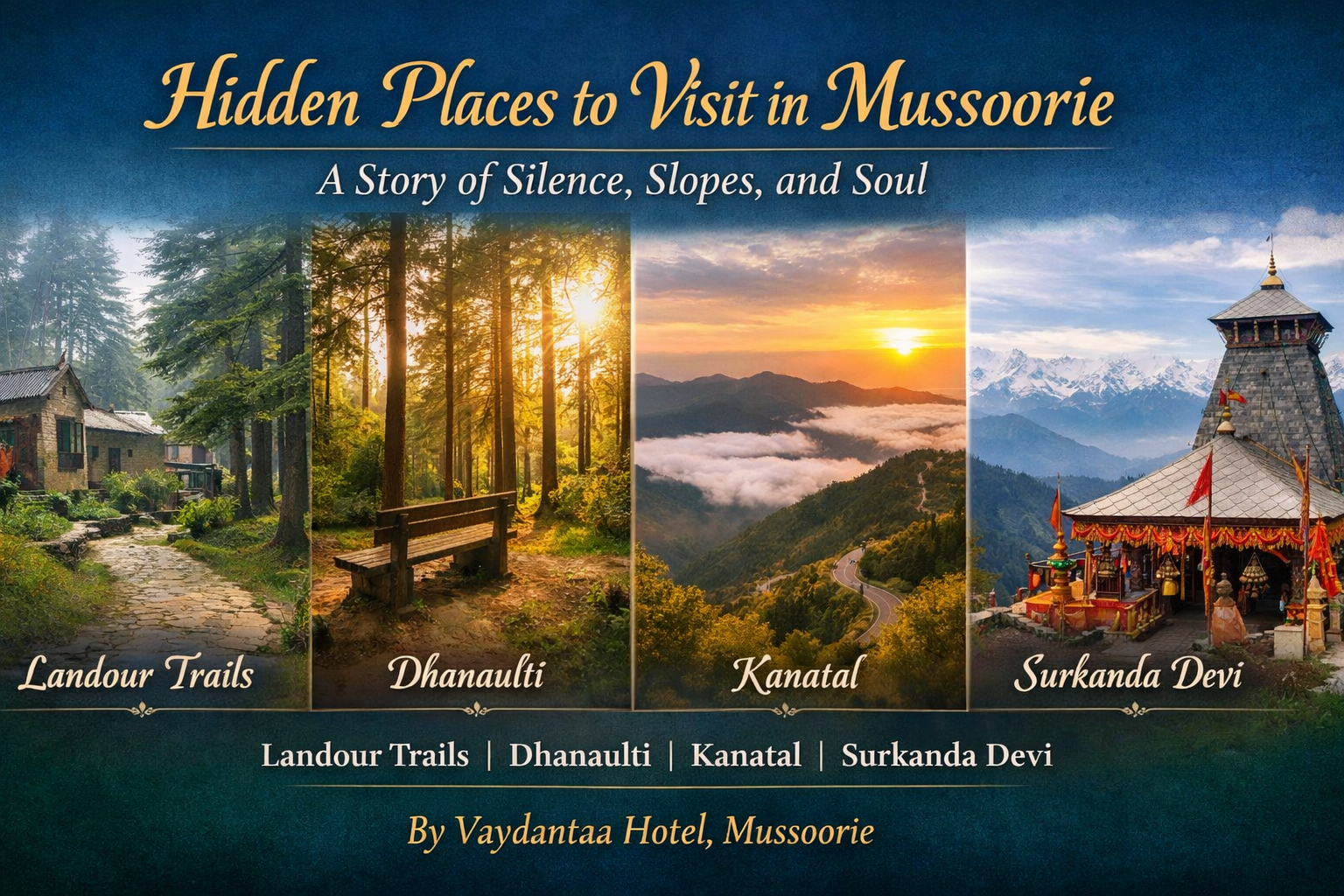
Landour Trails • Dhanaulti • Kanatal • Surkanda Devi
By Vaydantaa Hotel, Mussoorie
Hidden Places to Visit in Mussoorie – Every journey to Mussoorie begins with expectations.
For some, it’s the excitement of Mall Road lights.
For others, it’s the nostalgia of childhood holidays.
But for a few—those who listen closely—it’s something else entirely.
It’s the quiet pull of the hills asking you to slow down.
At Vaydantaa Hotel, mornings begin gently. The valley below still carries traces of mist, the sun rises without drama, and the mountains don’t rush to impress you. They simply are. And it’s in this calm that the idea of exploring Mussoorie differently takes shape—not by ticking landmarks, but by discovering places where the hills speak in whispers.
This blog is not a checklist.
It is a story-led journey into Mussoorie’s hidden side—where paths curve instead of crowds, where forests breathe instead of bustle, and where every place leaves something behind in you.
We invite you to walk with us beyond the obvious—into Landour Trails, further into Dhanaulti, deeper into Kanatal, and finally upward to Surkanda Devi—a journey that transforms a holiday into a memory that stays.
Mussoorie has changed over the years. Like all beautiful places, it attracts attention—and attention brings noise. But the magic of Mussoorie has not disappeared; it has merely shifted slightly away from the main road.
Hidden places matter because:
They let you experience the hills without interruption
They reconnect you with nature, silence, and yourself
They allow you to travel without exhaustion
They remind you why mountains heal
These places are not secret because they are unknown.
They are hidden because most people don’t slow down enough to reach them.
Landour does not announce itself loudly. There are no flashy signboards or dramatic entrances. One moment you’re in Mussoorie, and the next, the air feels cooler, the road quieter, and the world softer.
Landour is Mussoorie’s older, wiser sibling.
Here, colonial-era cottages sit comfortably among tall deodar trees. Moss grows patiently on stone walls. The lanes curve as if protecting secrets passed down for generations.
Walking through Landour is not about reaching somewhere.
It’s about being somewhere.
The most beautiful way to experience Landour is on foot. Begin your walk near Char Dukan, move toward Sister’s Bazaar, and continue upward toward Lal Tibba.
This walk is not difficult, but it is deeply rewarding.
The silence feels intentional
The trees seem taller than elsewhere
Every turn reveals a view or a moment worth pausing for
You’ll notice how conversations naturally lower in volume. Even laughter feels softer here. Landour teaches you, gently, how to behave in the hills.
Char Dukan is not famous because it tries to be. It’s famous because it doesn’t.
A few small eateries, basic wooden benches, hot food, and slow mornings—that’s all. And yet, it feels perfect.
Sit with a cup of tea or coffee. Watch locals pass by. Listen to the wind move through trees. You’ll realize that luxury isn’t about options—it’s about absence of noise.
As you walk further, Sister’s Bazaar appears quietly—like a village that never intended to become a tourist spot.
Here, shops sell essentials rather than souvenirs. Locals greet each other by name. Life continues at its own pace, undisturbed by trends.
This is where Landour reveals its soul—not curated, not staged, just real.
Reaching Lal Tibba feels less like an achievement and more like a gift. It’s one of the highest viewpoints around Mussoorie, offering sweeping views of the Himalayan ranges on clear days.
But even when the peaks hide behind clouds, Lal Tibba does not disappoint. Fog adds mystery. Silence adds depth.
Stand there long enough, and you’ll feel something settle inside you—a sense of being exactly where you’re meant to be.
After a day in Landour, returning to Vaydantaa Hotel feels natural. Not because you’re tired, but because you’re content.
The comfort of the room, the warmth of food, and the valley view allow you to reflect—not scroll.
Landour doesn’t exhaust you.
It prepares you.
The drive from Mussoorie to Dhanaulti is where the scenery begins to stretch its arms. Traffic thins. Pine trees become denser. The air sharpens.
Dhanaulti doesn’t welcome you with excitement—it welcomes you with calm.
This is where the hills stop performing and start existing.
Dhanaulti’s Eco Park is not about attractions. It’s about atmosphere.
Tall deodar and oak trees line simple walking paths. There’s no rush to finish a circuit. You walk, pause, sit, and walk again.
What makes Eco Park special is how it makes you aware of small things:
The sound of dry leaves underfoot
Sunlight breaking through branches
The feeling of lungs filling with clean air
You don’t “do” much here—and that’s exactly the point.
Pine forests have a way of slowing the heart rate. In Dhanaulti, this effect feels amplified. The forest doesn’t demand attention—it offers comfort.
Sit on a bench. Close your eyes. Breathe.
In a world obsessed with productivity, Dhanaulti reminds you that rest is also progress.
Most visitors walk, take photos, and leave.
Instead, try this:
Walk without your phone for the first 20 minutes
Sit without music for another 10
Observe your thoughts slow down
Dhanaulti doesn’t just relax your body—it quiets your mind.
After Dhanaulti, Mussoorie feels different. Quieter. Kinder.
Back at Vaydantaa Hotel, you’ll notice how deeply you sleep that night. Forest air has a way of rearranging rest.
If Dhanaulti is gentle, Kanatal is expansive.
The landscape opens up. The sky feels larger. The roads stretch longer without interruption.
Kanatal doesn’t crowd you with sights. It gives you space.
The Kaudia Forest walk is one of Kanatal’s most grounding experiences. The trail moves through dense forest and open stretches, allowing you to feel both protected and free.
Here:
Every footstep sounds intentional
Every pause feels earned
Every view appears unexpectedly
The forest feels alive, but not intrusive. It watches you, not the other way around.
Kanatal shines when you let go of plans.
Sit at a viewpoint. Watch clouds drift. Let time stretch.
There’s no urgency here. No pressure to capture moments. Kanatal teaches you how to exist without expectation.
As evening approaches, Kanatal wraps itself in golden light. Shadows lengthen. The temperature dips slightly.
You don’t leave Kanatal with excitement.
You leave with clarity.
The journey to Surkanda Devi begins early. Whether you choose the trek or the ropeway, there is a sense of anticipation.
The climb is not just physical—it’s emotional.
With every step upward, distractions fall away. Conversations quiet. Thoughts simplify.
The trek rewards effort. The forest path, the incline, the rhythm of walking—it becomes meditative.
The ropeway offers accessibility, allowing more people to experience the summit without strain.
Both paths lead to the same place—but the journey shapes the experience.
At the top, Surkanda Devi Temple stands calmly against the sky.
There is wind. There is space. There is stillness.
People sit quietly. Some pray. Some simply stare at the horizon.
Regardless of belief, the place invites humility. You feel small—but not insignificant.
From Surkanda Devi, the hills stretch endlessly. Valleys dip and rise. The sky feels closer.
You don’t just see farther.
You understand more.
This is where the journey completes itself.
Morning walk through Char Dukan, Sister’s Bazaar
Lal Tibba viewpoint
Evening rest at Vaydantaa Hotel
Eco Park forest walk
Quiet lunch and reflection
Early return for rest
Kaudia Forest walk
Surkanda Devi ascent
Evening return with calm satisfaction
These places remain special because they are respected.
Avoid loud music
Carry your waste back
Walk more, drive less
Respect local life
The hills give generously—but they remember how you treat them.
When you return to Vaydantaa Hotel after exploring Mussoorie’s hidden places, something has shifted.
You may not notice it immediately.
But later—back home—you’ll realize:
You breathe a little deeper
You rush a little less
You remember the silence
Hidden places don’t shout for attention.
They leave quietly—and stay forever.
Mussoorie is more than a destination.
It’s a conversation.
And if you listen closely, beyond the noise, beyond the crowds, beyond the obvious—you’ll hear the hills whisper back.
We’ll be here when you return.
One of the biggest reasons travelers search for Hidden Places to Visit in Mussoorie is the desire to escape crowded viewpoints and experience the true charm of the Queen of Hills. While Mall Road and Gun Hill remain popular attractions, the surrounding landscapes offer untouched forests, peaceful mountain trails, charming villages, and breathtaking viewpoints that many visitors overlook. Exploring these hidden gems allows you to enjoy nature at its purest, interact with local culture, and capture unforgettable Himalayan views without the hustle of commercial tourist spots. Whether you’re a solo traveler, a couple, or a family, these offbeat destinations create memories that last far beyond the trip itself.
Choosing the right accommodation enhances your journey to the Hidden Places to Visit in Mussoorie. Located near the scenic hills, Vaydantaa Hotel serves as an excellent base for exploring destinations like Landour, Dhanaulti, Kanatal, and Surkanda Devi. After a day of sightseeing, guests can unwind in comfortable rooms, admire panoramic valley views, and enjoy the peaceful mountain atmosphere. The hotel’s convenient location reduces travel time, allowing visitors to spend more time discovering Mussoorie’s hidden treasures and less time commuting, making every holiday more relaxing and memorable.
Some of the best hidden places to visit in Mussoorie include Landour Trails, Dhanaulti, Kanatal, and Surkanda Devi. These destinations are away from Mall Road crowds and offer serene forests, scenic walks, and spiritual calm. Staying at Vaydantaa Hotel makes it easy to explore these offbeat locations while enjoying comfort, valley views, and a relaxed base in Mussoorie.
Landour Trails are among the most charming hidden places to visit in Mussoorie because of their quiet lanes, colonial-era cottages, and forested walking paths. Unlike busy tourist spots, Landour offers slow travel, panoramic views, and peaceful cafés. Guests staying at Vaydantaa Hotel often choose Landour for morning walks and soulful experiences that showcase Mussoorie’s calmer, older character.
Yes, Dhanaulti is absolutely worth visiting if you want to explore hidden places near Mussoorie. Known for its Eco Park and dense pine forests, Dhanaulti offers fresh air, easy walks, and minimal crowds. From Vaydantaa Hotel, Dhanaulti makes for a perfect half-day or full-day trip, ideal for travelers seeking nature, silence, and stress-free exploration.
Kanatal stands out among hidden places to visit in Mussoorie due to its wide-open landscapes, forest trails, and slow-paced atmosphere. The Kaudia Forest walk and quiet viewpoints make it perfect for meditation, photography, and relaxation. Guests often combine a Kanatal visit with their stay at Vaydantaa Hotel to balance comfort with immersive nature experiences.
The Surkanda Devi trek is considered moderate and manageable for beginners with basic fitness. It is one of the most rewarding hidden places to visit near Mussoorie, offering spiritual significance and stunning Himalayan views. Travelers staying at Vaydantaa Hotel often plan an early-day visit to Surkanda Devi, ensuring a comfortable pace and enough time to rest afterward.
The best time to explore hidden places to visit in Mussoorie is from March to June and September to November. These months offer pleasant weather, clear views, and comfortable walking conditions. Winter visits are also beautiful for snow lovers. Staying at Vaydantaa Hotel during these seasons ensures easy access to offbeat destinations while enjoying warm hospitality.
Yes, most hidden places to visit in Mussoorie like Landour, Dhanaulti, and Kanatal are family-friendly. They involve gentle walks, scenic drives, and peaceful environments suitable for all age groups. With its comfortable rooms and calm surroundings, Vaydantaa Hotel is an ideal stay option for families looking to explore Mussoorie beyond crowded tourist areas.
A well-planned 3 to 4-day trip is ideal to explore the best hidden places to visit in Mussoorie without rushing. You can dedicate one day each to Landour, Dhanaulti, and Kanatal–Surkanda Devi. Staying at Vaydantaa Hotel allows you to return to a relaxing environment each evening, making your trip both comfortable and enriching.
Absolutely. The quiet charm of Landour, the forests of Dhanaulti, and the scenic views of Kanatal make these hidden places to visit in Mussoorie perfect for couples and honeymooners. They offer privacy, romance, and natural beauty. Vaydantaa Hotel complements this experience with a peaceful stay, valley views, and a serene atmosphere ideal for couples.
Vaydantaa Hotel is an excellent choice for travelers exploring hidden places to visit in Mussoorie because it combines comfort, scenic surroundings, and convenient access to offbeat destinations. After long walks and day trips to Landour, Dhanaulti, Kanatal, or Surkanda Devi, guests can return to a calm space designed for rest, reflection, and memorable mountain stays.